-
info@wheelspeedsensor.com
-
578-393-4937
-
447 Broadway 2nd floor, New York, NY 10013, United States

How Does a Speed Sensor Work? A Simple Guide to Types and Signals
Your car measures wheel rotation many times each second. That steady stream of data helps the brakes, speedometer, transmission, and steering work together. Learning how does a speed sensor work gives you a clearer view of what those systems need and what a warning light is trying to tell you. This guide walks through the two main sensor designs, the signal each one produces, and the simple checks that show whether the signal is healthy. You do not need an engineering degree to follow it.
What a Speed Sensor Measures
A speed sensor measures how fast a rotating part turns. On a car, that part is usually a wheel, a transmission shaft, or an axle. The sensor does not measure speed in miles per hour directly. It produces a pulse or a wave, and the control module calculates speed from how often those pulses arrive.
Think of a bicycle wheel with a magnet on one spoke and a small pickup on the fork. Each pass of the magnet creates one signal. Two passes per second means the wheel is turning twice per second. The module knows the wheel’s circumference, so it can turn that rate into road speed.
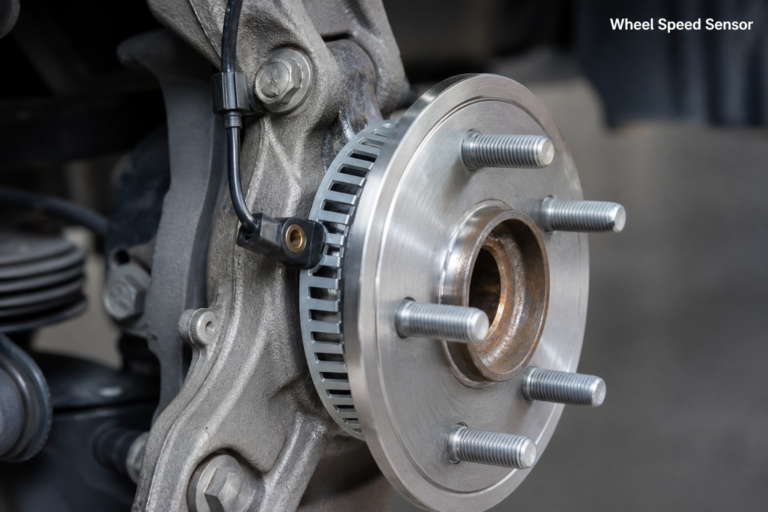
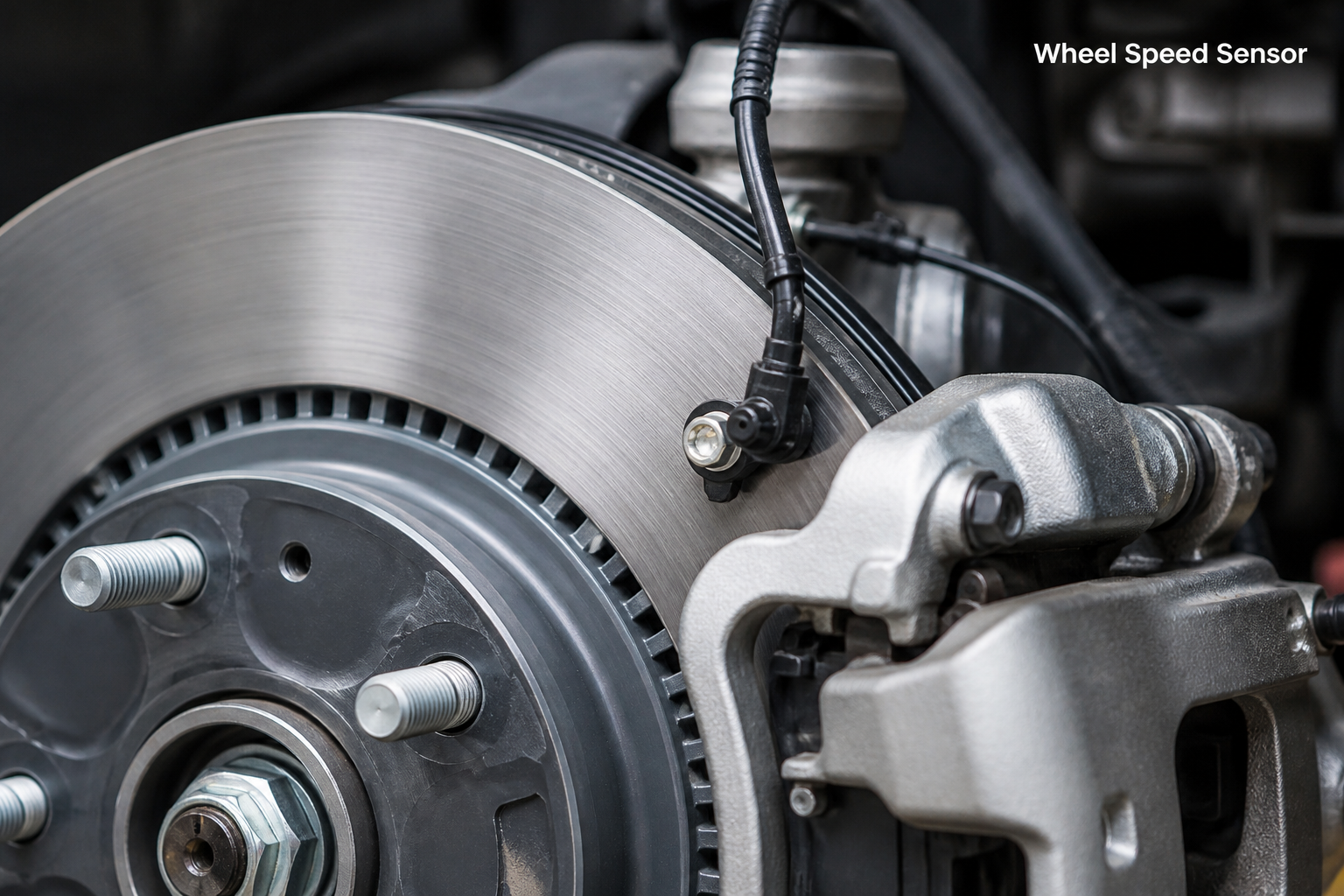
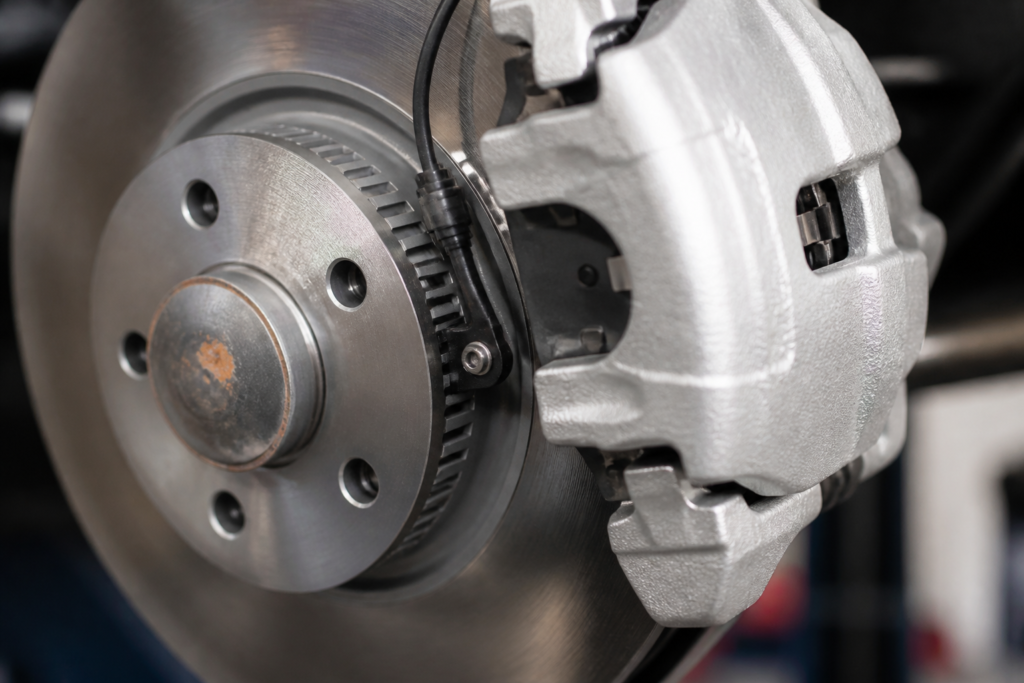
Cars use the same idea at a much finer scale. A tone ring with many teeth spins past the sensor. More teeth mean more pulses per turn, which gives the module a precise view of speed, even at walking pace.
The Two Main Designs: Passive vs Active
Most speed sensors fall into one of two families. The quickest way to tell them apart is the number of wires and whether the sensor needs power from the car.
Passive (inductive) sensors: a tiny generator
A passive sensor has a coil and a magnet inside. It usually has two wires and no external power supply. As the teeth of the tone ring pass the magnetic field, they change the field and induce an AC voltage in the coil. The faster the ring turns, the higher the voltage and the frequency.
Because the sensor generates its own signal, it needs no power from the module. That simplicity is a strength. It also means the signal gets weaker as speed drops. At very low speed, a passive sensor may produce a signal too small for the module to read reliably.
Active (Hall-effect) sensors: a powered switch
An active sensor needs a reference voltage from the ABS module or another control unit. It usually has three wires: power, ground, and signal. Inside, a Hall-effect element or a magnetoresistive element detects changes in a magnetic field and switches the signal output between two voltage levels. The result is a digital square wave.
Active sensors can report very low speeds, including zero. That makes them useful for hill-hold, low-speed traction control, and parking systems. They also produce a consistent signal amplitude across the speed range, which makes diagnosis more predictable.
A practical point from the trade: never perform a resistance test on an active sensor. The meter sends a small current through the circuit, and that current can damage the electronics inside. Use a scope or a meter that can read the signal while the sensor is powered. The diagnostics guide from Brake & Front End on active wheel speed sensor logic explains the supply voltage and the small signal swing in more detail.
How the Control Module Turns Pulses Into Speed
The module counts pulses or measures the time between them. Both methods work. Counting pulses over a fixed window is simple. Measuring the time between edges is more accurate at low speed.
Here is the key idea: the module does not need to know the absolute voltage of every pulse. It needs the timing. A clean edge, arriving at a predictable interval, is enough. That is why a damaged tone ring or a loose connector can cause a code even when the sensor itself is fine. The module sees a missing or irregular edge and reports a problem.
On a scan tool, you can often watch all four wheel speeds at once. A wheel that reads zero while the car moves, or that drops out for a moment, points to a specific corner. The data shows how the module interprets the signal. It does not show the waveform itself, but it is a good first clue.
Where the Signal Goes
A wheel speed sensor rarely serves only one system. The ABS module uses the signal to detect wheel lock and to pulse brake pressure. The same data feeds traction control and stability control. The speedometer may use it, or it may use a separate vehicle speed sensor on the transmission. The transmission module uses input and output shaft speeds to decide when to shift. Speed-sensitive steering uses vehicle speed to adjust assistance.
That shared use explains why one bad sensor can light up several warnings. The ABS light, traction control light, and speedometer can all react to the same missing signal. It also explains why a scan tool that reads only engine codes may miss the story. You need a tool that can see ABS and transmission modules.
What Changes as Speed Rises
For a passive sensor, both frequency and amplitude rise with speed. The waveform looks like a sine wave. At low speed it may be a small ripple. At highway speed it can be several volts.
For an active sensor, frequency rises with speed, but the amplitude stays roughly constant. The waveform looks like a square wave. The module sees clean high and low states rather than a smooth curve.
This difference matters when you test. A passive sensor can be checked for AC voltage while you spin the wheel. An active sensor needs power and a meter or scope that can capture a fast switching signal. Testing an active sensor like a passive one can send you down the wrong path, so match the test to the sensor design.
Passive vs Active: A Quick Comparison
Feature | Passive (inductive) | Active (Hall-effect)
|
Wires | Usually 2 | Usually 3 |
External power | No | Yes, from the module |
Output | AC sine wave | Digital square wave |
Signal at very low speed | Weak or absent | Reliable, often down to zero |
Amplitude as speed rises | Increases | Stays roughly constant |
Resistance test | Useful | Avoid; can damage the sensor |
Common use | Older ABS systems | Modern ABS, stability, low-speed features |
How to Tell Which Type You Have
Start with the connector. Two wires usually mean a passive sensor. Three wires usually mean an active sensor. That is a guide, not a rule. Some designs use two wires with a different internal circuit. The service information for your vehicle is the final word.
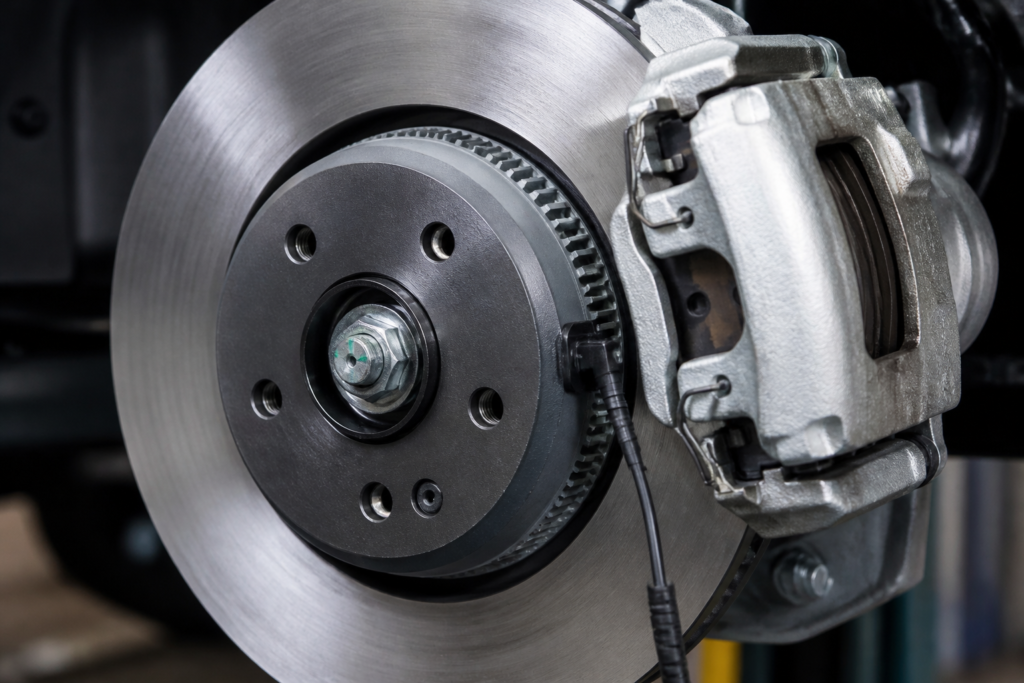
You can also look at the tone ring. A passive system often uses a toothed metal ring. An active system may use a magnetic encoder ring built into the wheel bearing. If the sensor is part of the hub assembly, the whole unit may need replacement when the encoder fails.
Check the shape of the sensor body as well. A passive sensor often has a longer, cylindrical body with a mounting flange. An active sensor may be shorter and sealed into the hub. Photos in a parts catalogue can help, but the connector and the service data are more reliable.
What Affects Signal Quality
The sensor is only one part of the path. Several conditions can weaken or distort the signal:
- Air gap: the distance between the sensor tip and the tone ring. Too large, and the signal gets weak. Too small, and the ring can contact the sensor.
- Debris: metal shavings, rust, and brake dust can bridge the gap or damage the tip.
- Tone ring condition: cracks, missing teeth, and heavy rust create gaps in the signal.
- Bearing play: a worn hub bearing lets the ring move, which changes the air gap as the wheel turns.
- Wiring and connectors: corrosion, chafing, and loose pins add resistance or break the circuit.
- Electrical noise: a poorly routed wire bundle can pick up interference from other systems.
A clean signal depends on all of these. Replacing the sensor will not fix a damaged tone ring or a worn bearing. That is why the best diagnosis starts with the whole path.
What a Healthy Signal Looks Like
A healthy signal is steady and repeatable. On a scan tool, all four wheel speeds should rise and fall together as you drive. On a scope, the waveform should have even spacing and no dropouts. A single missing tooth shows up as a regular gap. A damaged bearing can make the air gap change and the signal wander.
You can also compare the two sides of the car. During a slow turn, the inside wheel should read slightly slower than the outside wheel. That small difference is normal. A sudden drop to zero, or a reading that jumps far above the others, is not.
If you see a problem, resist the urge to replace the sensor first. Check the connector, the wiring, the tone ring, and the bearing. A clean signal depends on all of them. The article on how to test a wheel speed sensor walks through the full sequence.
Frequently asked questions
Does a speed sensor measure speed directly?
No. It measures rotation and sends a signal. The control module calculates speed from the signal’s frequency and the known size of the wheel or shaft.
Can I drive with a bad speed sensor?
Often you can, but the car may lose ABS, traction control, or cruise control. The speedometer may read incorrectly. Treat it as a prompt to inspect the system soon, not as a reason to panic.
Are all speed sensors the same?
No. Passive and active sensors work differently, and connectors, mounting styles, and signal types vary by vehicle. Match the part to your make, model, year, and system.
Why does one bad sensor affect so many systems?
Several systems share the same speed signal. When one sensor drops out, each system may respond in its own way. That is why one fault can trigger several warning lights.
What is the difference between a wheel speed sensor and a vehicle speed sensor?
A wheel speed sensor measures one wheel. A vehicle speed sensor usually measures transmission or axle output speed. Some cars use wheel speed data for the speedometer instead of a separate vehicle speed sensor.
The signal is easier to understand than it looks
A speed sensor turns motion into a repeatable signal. The module reads that signal, compares it with the other wheels, and uses it to keep braking, shifting, and steering in balance. Once you know whether you have a passive or active sensor, the tests and the repair path become much clearer.
If a warning light has you curious, start with the basics: identify the sensor, inspect the tone ring, and watch the live data. The guide to speed sensor symptoms helps you connect the light to the likely cause. And if you are new to the part, what a speed sensor is gives you the big picture before you pick up a tool.